

Ten prettiest sailing yachts ever. Number 4: Whirlwind II

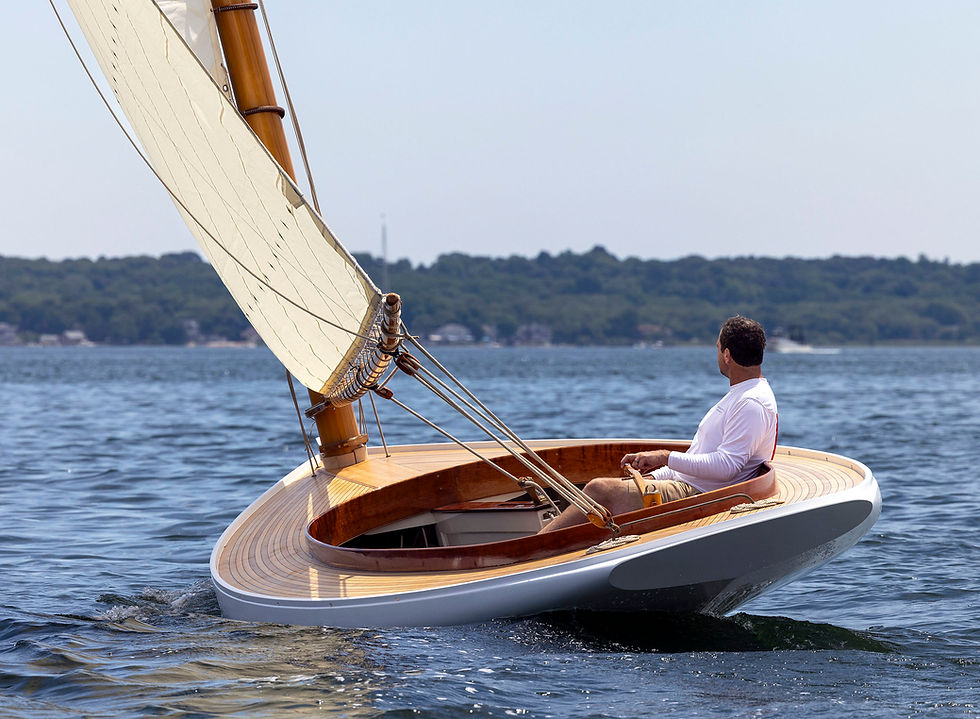
Whirlwind II, with owner Yarrow Thorne at the helm. Photo by Alison Langley
After two decades on the staff of Classic Boat, it's not that often I see a photo and think... holy shit. A lovely yacht by Fife or Watson won't quite do it any more (my own fault; too much eye candy rots your brain). Neither will a normal catboat – the sort we Brits think of when we think of the type: half as beamy as it's long, mast as thick as Jeff Capes's forearm, mad-looking barndoor tiller hung off the transom and a cartoon-boat cabin trunk. I love those things, but... you know... the brain rot.
Whirlwind II, a replica of a real Gil Smith catboat (Mariam, built around 1900 for Gil himself and his wife) is just so different, so sleek, so uncompromising, that I was taken aback when her story made her way to us at Classic Boat. But is she really a catboat? She's 26ft long but only 8ft 6in in the beam. That's a similar beam to length to something as ordinary as a Westerly Centaur. So what's going on? Does she even count as a catboat? Does it matter?
Builder Alec Brainerd of Artisan Boatworks in Maine is on hand to help. Gil Smith was an extraordinary designer, he tells us, not quite the 19th-century figure one might envisage, that of the pragmatic half-modeller satisfying the needs of local fishermen with a series of similar, vernacular designs. He was, like most of his contemporaries, a half-modeller, but by the time he created Mariam, catboat sailing had become racing yachts for the middle classes, and Gil Smith was the scratch designer; he was in short, an early designer of racing yachts. "Gil Smith boats were very distinctive – there's nothing else quite like them that I am aware of" says Alec.
Part of Whirlwind II's beauty is in the stern overhang. You might assume, as I did, that it's a yachty flourish befitting the racing age of the catboat, but Alec's guess is that the overhang keeps fishing gear clear of the rudder. The slight tumblehome towards the stern allows one of those soft, oval transoms loved by Americans, which can sometimes look sentimental, but it fits like a glove here.
And what about the deck? Swept decks, along with J-Class yachts, are usually things that excite others more than me, but on Whirlwind II it's the perfect choice, accentuating the flare out towards the centre of the boat; a few darker planks really ram the point home. Sharper eyes might notice that the deck planks on the aft deck don't joggle into a king plank where they meet, which is unusual, but it is a Gil Smith feature; the deck planks do meet in a king plank forward of the cockpit, where extra strength is needed in way of the mast.
Finally, there is the complete absence of deck gear, part of her incredible look. This, again was original to the type. These were fishing boats built for oyster and clam fishermen of Long Island Sound, and any appendages would snag the gear while hauling in and setting out. So the beauty of the clean decks has an antecedent in actual purpose. No jib? Great! No gib tracks or lizards then. No fairleads or cleats for tying up alongside? No problem. Tie a warp around the mast. The only thing you'll see on the decks of Whirlwind II is a slim, unobtrusive mainsheet horse aft of the cockpit, where it belongs. And the body-coloured toerail, again a rare touch, is as sleek as we thought body-coloured bumpers were on cars, when we first saw them in the 1980s.
Whirlwind II is one of those perfect collaborations between a discerning owner (Yarrow Thorne), a designer steeped in catboats since childhood (Ezra Smith) and a boatbuilder with a passion for beautiful day boats (Alec Brainerd) working in harmony to recreate a an indigenous type that would otherwise have remained as a dusty half-model for eternity.
It's perfection, isn't it?
Read Whirlwind's story in the current (March 2026) issue of Classic Boat. It's free and online here
See Off Center Harbor's great video on the project here
See what else Artisan get up to by clicking here
See designer Ezra Smith's website here
And see more of Alison Langley's work here
Thanks to Alec Brainerd for the education and Alison Langley for the amazing photo


Comments